Caricature as Social Control
The three foundational racist stereotypes, the hyper-sexualized Jezebel, the desexualized Mammy, and the aggressive Sapphire. These harmful tropes, analyzed as artistic and cultural artifacts, functioned deliberately as social control mechanisms used to enforce subservient behavior and dehumanize Black women in the perception of white society.
THE JEZEBEL

The Jezebel is defined as the “bad-black-girl”. This stereotype was popularized during slavery, depicting Black women as having an “insatiable appetite for sex”. This portrayal served as a rationalization for sexual relations, including rape between white men and enslaved Black women, by suggesting that the enslaved women desired the white men. The depiction of Black women as Jezebels was common in American material culture across centuries. Everyday items like swizzle sticks and fishing lures, such as the “Virgin Fishing Lucky Lure” or “ZULU LULU” swizzle sticks, showed Black women as “one-dimensional sexual beings”.
THE MAMMY

The Mammy is one of the three core historical images of Black women. She is characterized by domestic service and loyalty, and is consistently defined by a lack of sexual threat. This stereotype served to position Black women as “antithetical to the hypersexualized Jezebel caricature”Historical commercial imagery, such as the pre-21st century “Aunt Jemima” branding, represents this figure. The Mammy archetype was the dominant popular cultural image of Black women from the slavery era until the 1950s.
THE SAPPHIRE
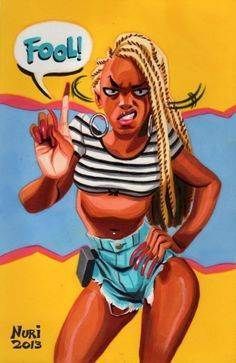
The Sapphire is defined as the “second media image of black women”. She is consistently portrayed as an “aggressive, rude, and verbally assaultive” figure. She is often depicted with physical features like short or nappy hair. Her image functions as a mechanism of social control against assertive women. By the 1970s, blaxploitation movies popularized new caricatures, including the Jezebel and the Sapphire. Actresses in these films were increasingly limited to Jezebel type roles. Even when central, stars like Pam Grier and Tamara Dobson were cast as physically attractive and aggressive rebels, often functioning as whores or “sexual fodder”.
What are black artist’s today doing to counter these stereotypes?
While the Trope Triad dominated popular visual culture, early efforts to resist these oppressive ideals were underway. Free Black women in the mid-nineteenth century used portraiture, such as Tintypes from the 1860s, to create “new visual representations of Black people”. By arriving at photography studios in elegant attire, they countered a “long history of contemptuous representations” by projecting Black pride and identity. These images were crucial in asserting that Black women belonged in American society and had agency over their own bodies and appearances